


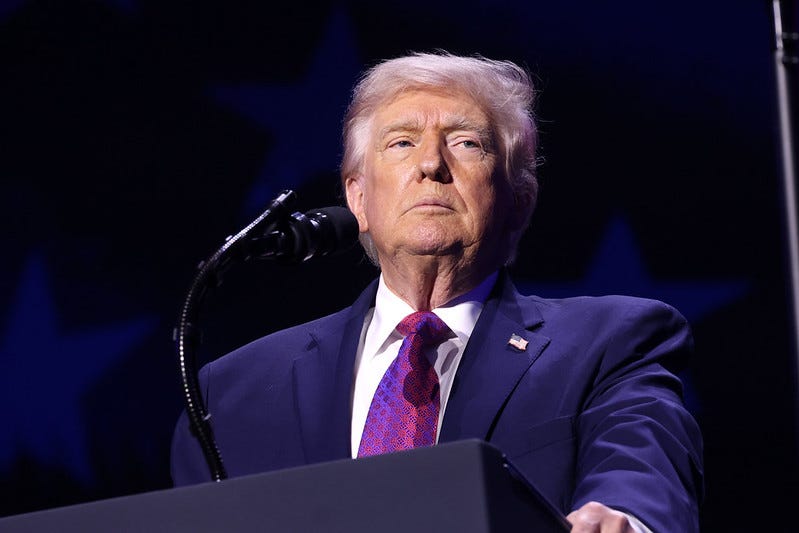
Republican Party leaders have promised that their midterm convention, which begins tonight in Dallas, will be a primetime “Trumpapalooza” — a mega pep rally aimed at showcasing the president’s supposed successes and revving up his most hardcore fans so that they’ll turn out to the polls in November.
But judging by the event’s agenda, there appears to be at least one piece of our unpopular president’s record that’s so obviously politically toxic that his party is not even willing to pay it lip service in front of an adoring crowd. Across the two days of speeches, there is not one mention of national defense or foreign policy anywhere in the program.
Historically, the omission of these topics from a Republican Party convention would have been unthinkable. Since the late 1980s, voters have traditionally trusted Republicans over Democrats when it comes to keeping the country safe from international terrorism and military threats — at times by very wide margins. During those years, the GOP embraced the mantle of Reagan’s “peace through strength” Cold War legacy, and attached themselves to the rally-around-the-flag response that carried the George W. Bush administration in the months and years after September 11, 2001.
The programming gap is even more glaring in the middle of war with Iran where at least 18 American servicemembers have lost their lives and over 750 have been wounded in action, with no apparent end in sight.
Could you imagine the 2004 RNC agenda entirely skipping any mention of the wars in Iraq and Afghanistan, failing to recognize the sacrifices of U.S. servicemembers or make the case to the nation for what America was fighting for? And yet, that is exactly what is happening in 2026. The closest Donald Trump’s Republican Party will come to discussing the foreign policy of the United States is apparently a session on the return of Americans held hostage overseas, consigned to the 4 p.m. hour on day 2. It’s possible Trump or Vance will spend some time on the subject during their speeches, but the rest of the GOP looks ready to treat it as radioactive.
It’s hard to blame them, really. After all, Trump has embraced dictators, alienated allies, and plunged America into a Middle Eastern quagmire after promising no new wars. By the time Americans cast their votes in November, he will have spent the first two years of his second term systematically torching America’s standing in the world, not to mention our munitions stockpiles.
It can be difficult to even keep track of all the embarrassing lowlights. Trump’s threats to turn Canada into the 51st state failed to win any trade concessions, but did push our northern neighbor closer to China. His fixation on acquiring Greenland deeply rattled our NATO allies, with little to no upside. He literally rolled out the red carpet for Russian leader Vladimir Putin after lambasting Ukraine’s Volodymyr Zelenskyy in the Oval Office, only for Russia to offer Iran military assistance. After he scaled back long-planned military drills with South Korea while calling North Korean dictator Kim Jong Un “unthreatening and respectful,” the Kim regime dismissed the gesture as “unworthy of comment.”
Trump’s petty grudges have, of course, even extended into changing the names of international bodies of water in fits of pique. It turns out that the American people consider this behavior better suited to internet trolls than presidents — polling has consistently shown over 70% oppose renaming the Gulf of Mexico the “Gulf of America,” and initial YouGov poll results put disapproval of “Lake America” at over 60%.
Trump’s foreign policy has been so disastrous, some of America’s oldest allies have begun openly talking of “de-risking” their relationships with the U.S., using a term that originally meant reducing damaging dependencies on an increasingly emboldened China to now mean protecting themselves from Trump.
Despite Republicans’ desire to keep the focus domestic at their party conference, they cannot outrun the shadow that Trump’s war with Iran casts on inflation, energy, and the cost of living. The number of Americans who report feeling financially worse off has skyrocketed since the war began in February, not a surprise when the war has cost the average American household an extra $1,200 in bills and higher costs to date.
Americans have taken on financial hardships during conflicts before, with rationing and victory gardens becoming part of everyday life during the First and Second World Wars. But those Americans also understood why they were being asked to sacrifice and what America was fighting for. The Trump administration’s ever-shifting rationale for the Iran War — explanations have included self-defense from imminent Iranian attack, defense of Iranian protestors, prevention of nuclear capabilities, and regime change, amongst others — has translated to the American public not understanding why we’re there in the first place. Small wonder that public support for the conflict has never even approached net favorability.
This is not to say Democrats should take a victory lap or pat themselves on the back when it comes to defense and foreign policy. However unpopular the president’s policies may be, polls show Republicans still have a small lead on defense issues. And Democrats have yet to craft much of a vision of their own, beyond stopping Trump’s madness.
While rejecting radical flares of antisemitism, the party must find a way to reckon with an Israeli government that seems content to overlook IDF abuses and settler violence, and whose leader has shown his willingness to defy both Democratic and Republican U.S. administrations for domestic political gain. Democrats must also reject far-left calls for retrenchment and isolationism, and reassert that America can prioritize democracy and liberal values both at home and abroad.
There is no going backward from where America is today — no switch will flip in January 2029 that resets everything back to the pre-Trump era. That knowledge presents an opportunity, as does the abject failure of and ceding of ground by Trump and the Republican Party on a longtime trademark issue. At a moment when the GOP won’t even talk about its record abroad, Democrats would be wise to channel the legacy of forebears like FDR and Harry S. Truman and articulate a forward-looking vision for a new American foreign policy they can be proud to run on.

Indeed, let us hope leading Democrats resist the left’s calls for turning away from the world. Let’s hope they instead call for rebuilding alliances, including US efforts to arm allies and partners, as the way to confront China, Russia, Iran, North Korea, and sub-state threats like terrorists and pirates.